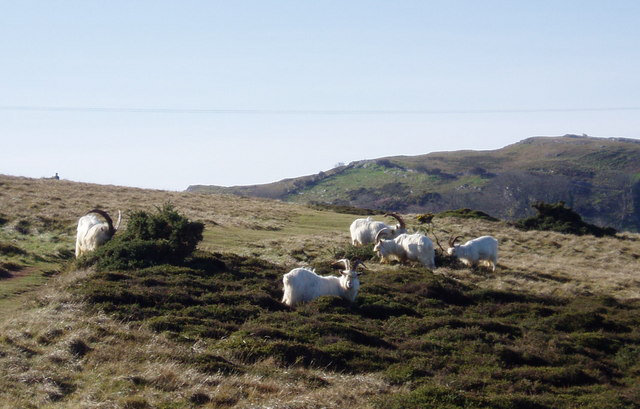
Many of you will recall that Muhammad Ali used to proclaim "I am the greatest". His wife then started using the acronym G.O.A.T, meaning Greatest Of All Time, for publicity purposes. What do Llandudno, Ventnor and Cromer have in common? Arguably, they may be described as the Greatest Of All Towns, but I doubt it! In fact, they are all seaside places that our group has visited in the last four years for one of our 4-night walking holidays organised by our redoubtable, but soon to be retiring social secretary, June. But more than that, they each have a resident goat population!
In October 2018, we stayed at Bodelwyddan Castle in North Wales and walked around the Great Orme in Llandudno where we spotted the goats that became famous during lockdown in 2021 for walking down into the town presumably wondering where everybody was!
The Great Orme Kashmiri goats, whose ancestors once roamed the mountains of Northern India, form a herd about 60 strong. They are frequently seen climbing the steep limestone cliffs browsing on narrow ledges. Since goats will eat almost anything they keep the Orme neatly manicured.
In the early part of the nineteenth century, Squire Christopher Tower, from Brentwood, Essex, imported Kashmiri goats from a herd in France with the idea of creating a profitable woollen industry. George IV was very impressed by the cashmere shawls produced and was happy to accept a pair of the goats presented to him by Squire Tower.
On her accession in 1837 Queen Victoria was also presented with Kashmiri goats, by the Shah of Persia, which were added to the existing Windsor herd. Later, the local landowner, Major General Sir Savage Mostyn, acquired two of these goats and brought them to the grounds of his home, Gloddaeth Hall near Llandudno.
After the Crimean War, Queen Victoria presented the 3rd Battalion of the Royal Welsh regiment with a Kashmiri goat from the royal herd, starting a tradition that continues to this day. All Royal Welsh goats hold the rank of Lance Corporal within the regiment.
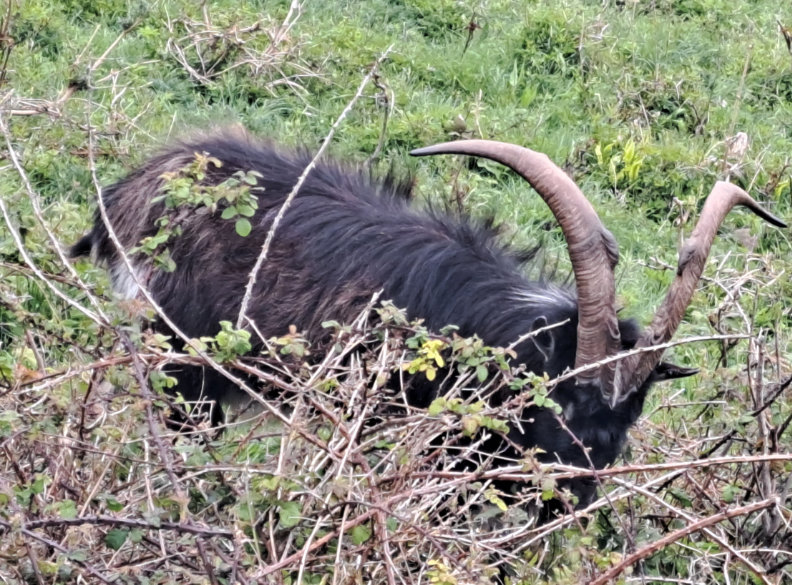
On our 'overseas' trip to Yarmouth on the Isle of Wight in April 2022, we stayed in a hotel on the coast next to the Robert Hooke Trail, some of which we walked. The trail commemorates the 17th century life of the 'local lad' who is the 'father of meteorology'. He invented a form of barometer, a wind gauge and a hygrometer, all of which he suggested should be used to log data which could then be used to forecast future weather.
Before our interplanetary amble, we came across a herd of Old English feral goats on Ventnor Downs. They were a bit difficult to spot, hidden amongst the remaining trees, but they are used by the National Trust for important conservation work, helping to restore the species-rich chalk grassland. Old English goats are an ancient breed, originally released in the Cheviots, Northumberland, in the 1860s. In 1993 the National Trust brought seven of them to the Isle of Wight. Their job is to control the spread of the holm oak trees planted around Ventnor by the Victorians. Since the goats were introduced onto the Downs, the holm oak has been brought under control gradually and the original chalk grassland restored. Flower-rich turf has been re-established and butterflies, like the Adonis Blue that prefers these chalk-loving plants, have increased in number.
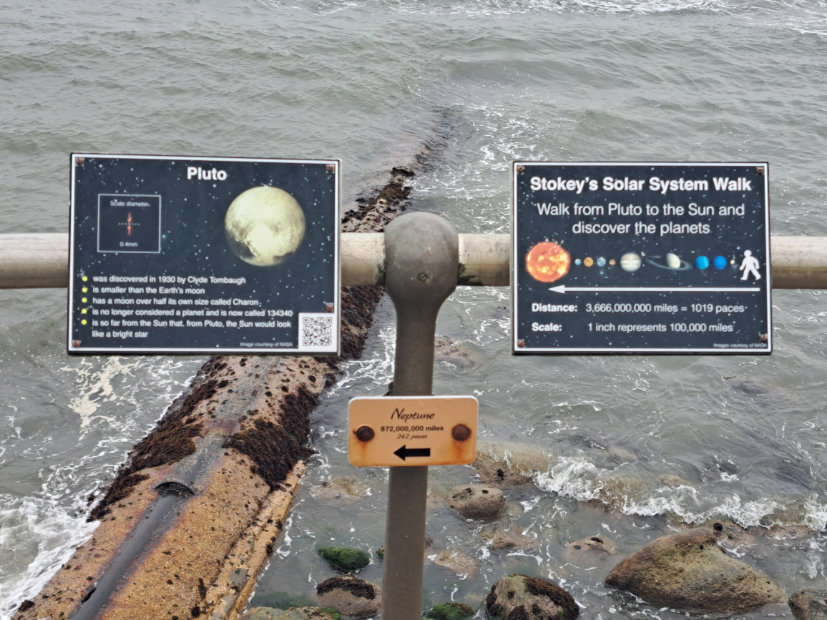
Another day on the isle was spent walking through the solar system — a scale model extending over a kilometre along the promenade to illustrate the relative distances between the planets. The astute will note that this is now out of date since Pluto has been downgraded from planetary status!
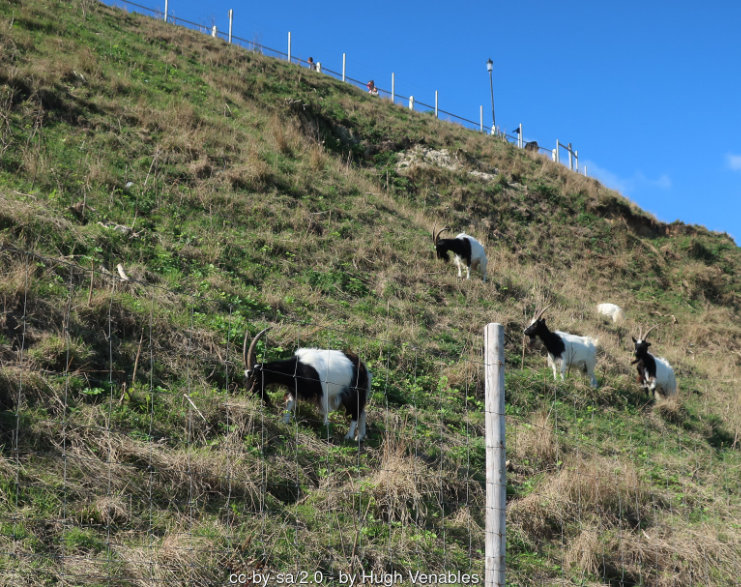
We have just returned from our latest holiday (October 2022) on the Norfolk coast in a hotel on the front at Cromer. Bagot goats are Norfolk County Council's most beloved employees. After wintering in Salthouse, in the summer they are released to take up residency on Cromer's cliffs to carry out an important habitat-management role which otherwise proves difficult and expensive for humans operating machines.
The return of the goats every summer is eagerly anticipated by locals and tourists, who have grown fond of seeing them traversing the grassy cliffs to carry out their vital environmental work. They even have their own merchandise which helps to fund their upkeep and make the project self-sustainable. It is estimated they save the council around £15,000 a year.
The Bagot is a breed that was probably brought to England by returning Crusaders and trace their ancestry to goats of the Rhone valley. They were given to John Bagot of Blithfield Hall by Richard II of England to commemorate the good hunting the king had enjoyed at Blithfield.
Next May we are off to Limpley Stoke near Bath but I'm not sure that we will find any goats except maybe in a local petting zoo or farm, but who knows!
Yasmin Vawda and Neil Whittall, Tonbridge and Malling Ramblers