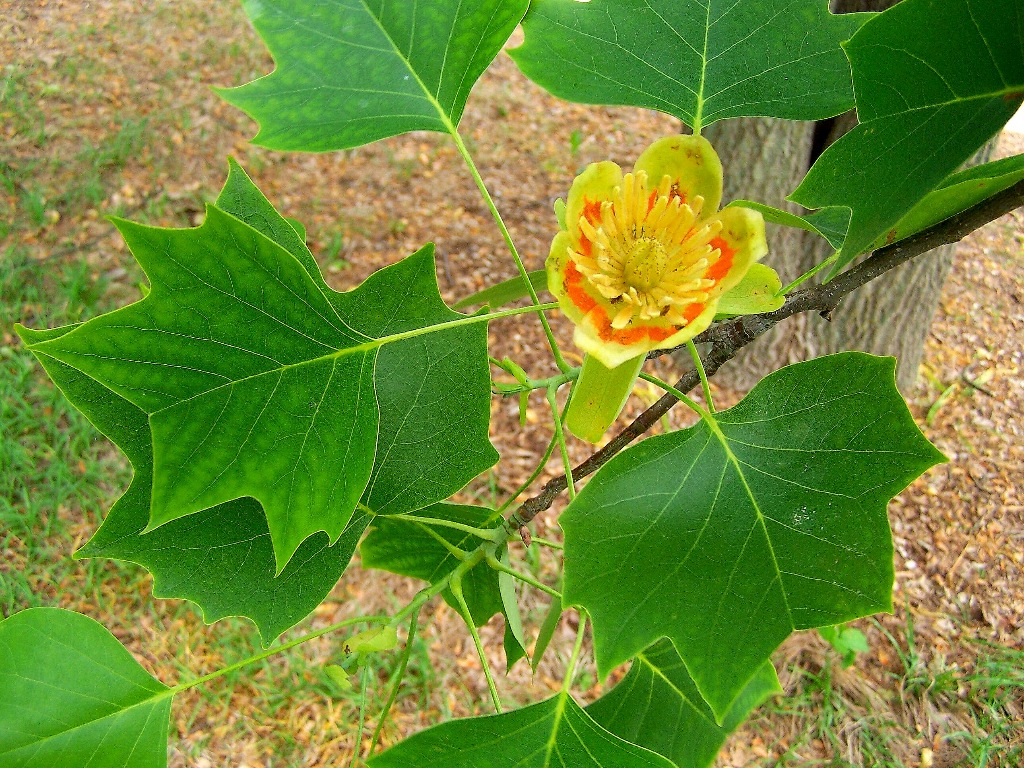
According to legend, as Adam and Eve were expelled from the Garden of Eden, Eve tried to grasp a branch of the Tree of Life but succeeded only in snatching the tip of a leaf from the tulip tree. So the leaves of the tulip tree have veins leading to a non-existent tip. To see the fine tulip-like flowers, visit in early June.
This is a legacy of the parkland of North Cray Place, landscaped by “Capability” Brown in the 1780s.
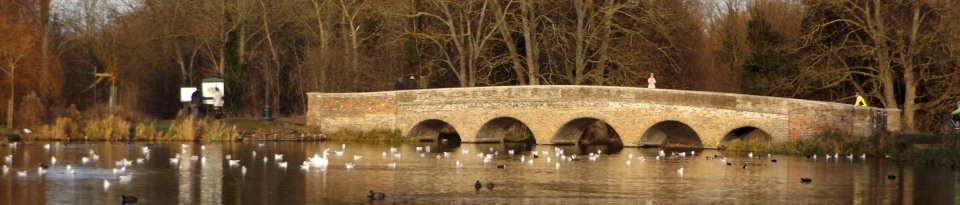
The Cray was dammed to create the lake lying up river from the bridge. North Cray Place was demolished in 1962 and a housing estate built on the site. The grounds became part of Foots Cray Meadows public open space.
The elegant white mansion you may glimpse across meadows on your left soon after crossing the bridge by the play area is Loring Hall, now a care centre. Under its previous name of Woollett Hall it was the residence of British Foreign Secretary, Viscount Castlereagh, from 1811 until 1822 when he committed suicide in the house.
The most recent mansion on the estate was built in 1754, one of four houses in England built to copy Palladio’s Villa Rotunda in Italy. Two of the others are Chiswick House and Mereworth Castle in Kent. After use by the military in World War II, the house was acquired by Kent County Council (Bexley was in Kent until 1965) as a museum. Unfortunately it burnt down in 1949 and what little remained had to be demolished, the grounds becoming part of Foots Cray Meadows.
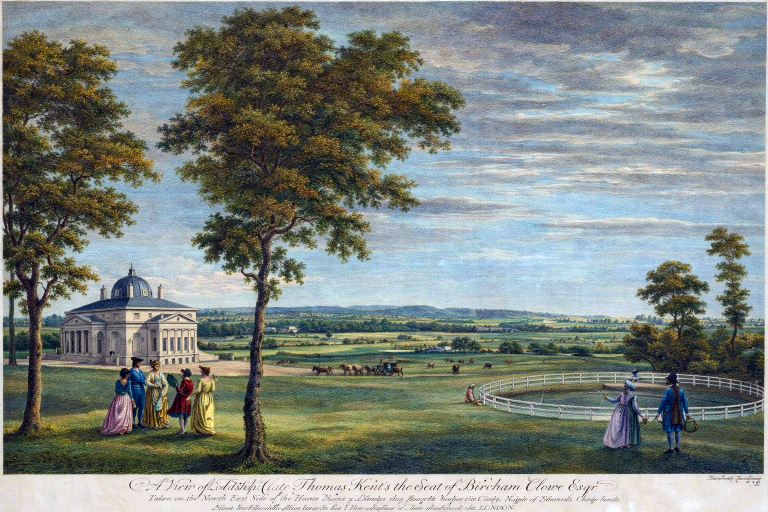
Foots Cray Place in a print of around 1760
Automatically migrated from https://www.kentramblers.org.uk/KentWalks/public/walk_005.htm on 2025-12-11 09:18